
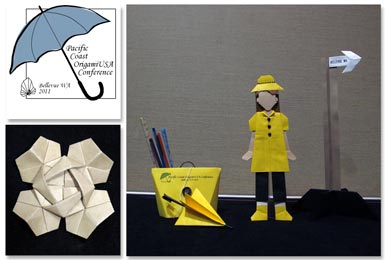
Since the Northwest Coast of the United States is known for frequent rain, the symbol for this year’s Pacific Coast Origami Convention –PCOC* was an umbrella. The convention was held in Bellevue, WA from September 29th to October 2nd.
• Patty Grodner created the lovely rainy-day-themed composition that she displayed at the PCOC exhibit -shown in the photo above, together with a piece folded by Mark Morden.

• The morning my flight arrived at the Seattle airport the sky was exceptionally clear in contrast to what I’d anticipated based on the Northwest’s rainy reputation. On approach, I had a magnificent view of Mount Rainier, a snow-covered conical volcano to the southeast of Seattle. I took this photo from the airplane (click to view enlarged photos).
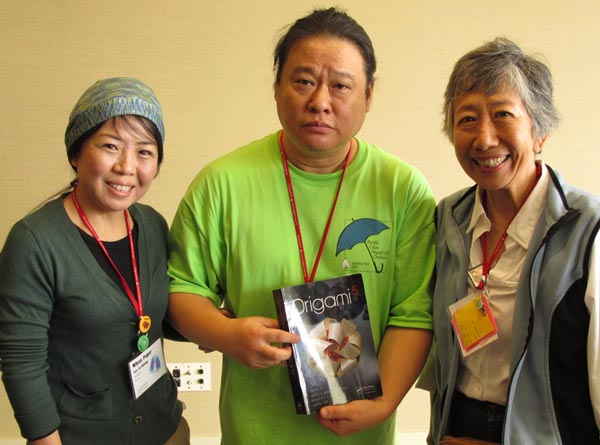
• Special PCOC convention guests this year were Seo Won Seon and Lee In Kyung, a couple from South Korea. Together they exhibited original models and taught several classes.
In the photo, Patsy Wang-Iverson (right) presents the book Origami 5: Fifth International Meeting of Origami Science, Mathematics, and Education to Seo Won Seon and Lee In Kyung. In this book is documented work presented at 5OSME the fifth in an ongoing series of conferences exploring connections between origami, mathematics, science, technology, education, and other academic fields. Together with Robert Lang, and Mark Yim, Patsy is one of this book’s editors.
• Well-known origami artist and author Peter Engel (US) was also a featured artist.
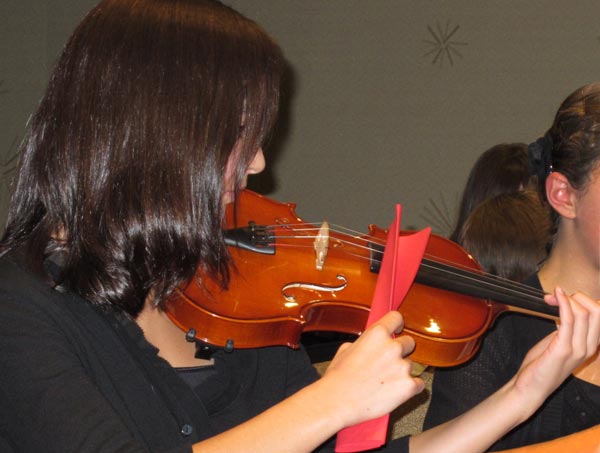
• On Saturday we were treated to a couple of charming performances during an evening of entertainment. Louie Foxx began by delighting us with his magic act. Mika Takano Tarmaly then led the Hamilton International Middle School Concert Orchestra in a performance of “Ear-igami” by composer Richard Meyer. The composition calls on musicians to use pieces of paper as instruments and it was for this latter performance especially that the origami crowd cheered and applauded with enthusiasm. Here is a rendition of Ear-igami, (played by a different orchestra).
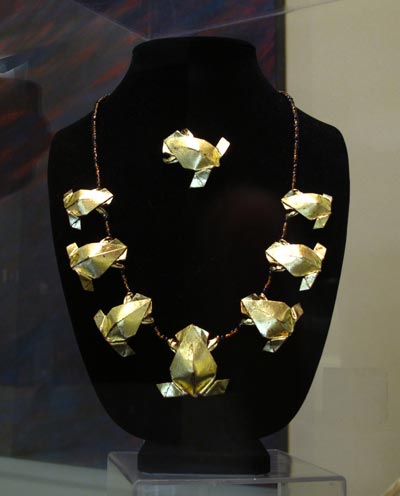
• There was an origami public exhibition at Lincoln Square (Bellevue) showcasing the works of several origami artists among which I was honored to be included. Two of my pieces, a pin and a necklace of gilt origami frogs, were part of this exhibit and inspired a number of students to take the class I offered on folding the frog model.
• This was my first attendance at PCOC. The convention days were full as I met up with old and newly made friends, and the time passed much too quickly. The convention organizers –Lori Gregory, Ray Takeuchi, Mark Morden, Terry Allen, Ayumi Hayatsu, Rabbitt Boyer, John Smiley, Kim & Gordon Crane, Lisa Song-Mayekawa, Mary Williams and Robert Orndorff, did an absolutely fabulous job in creating a memorable event! I returned to my home in Vermont satisfied and with many warm memories.
• Here are photos of some of the models I folded at PCOC both in classes and informally at the meeting room.
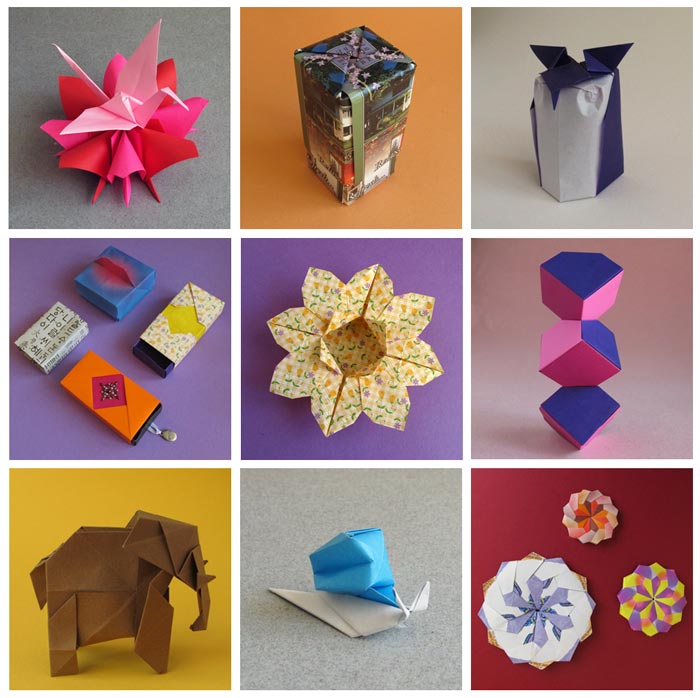
- Wind Charm Taught by Carol Stevens
- Modular Box Taught by Patsy Wang-Iverson
- Origami Owl Created and taught by Joseph Wu
- Boxes Various authors. Teachers: Kay Eng, Patty Grodner, Terry Hathaway
- Petal bowl Created and taught by Vicky Mihara Avery
- Stacking Cubes Created by D. Mitchel, taught by Char Morrow
- Origami Elephant Created and taught by Seo Won Seon
- Snail Taught by Karen Buse
- Eifel Star Created by Hans Werner-Guth, taught by Kathleen Sheridan
:::
* PCOC is pronounced “peacock”.
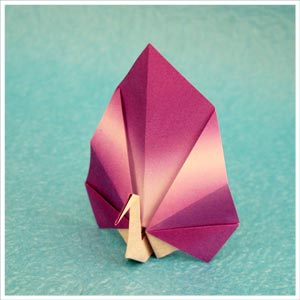
An origami peacock, designed by Kunihiko Kasahara, is the traditional symbol of PCOC.
Instructions for this peacock are found in the book Origami Made Easy* by Kunihiko Kasahara.
*Affiliate link, thank you for your support!
I have been trying to find origami classes for my 8 year old son for awhile. We visited the convention last year when it was in Bellevue, WA to look at all the exhibitions, but we can’t afford to register for the convention in Vancouver this year, even though it is geographically close to us. As a consolation to him, I have told him that I would try to find him a class to take. He is not like other 8 year olds…he has an incredible attention span and does intermediate to advanced (with some modifications to make it a little easier) origami for hours. He really wants to learn more and I would love to help him. I, too, love origami and understand his desire to move his skills forward.
I was hoping that someone on this site might know of some classes in Seattle or Bellevue. In the alternative, I thought you might know of a contact person that I could email with this same question. Thanks so much for your time, Kim and Aidan (son)
Hi Kim,
There are many regional origami groups that meet usually once a month. People interested in folding paper and exchanging ideas can join these local grops usually at no cost. Here is information found in the Regional groups page of OrigamiUSA http://origamiusa.org/groups_us
Here is a link for the regional group meeting in Bellevue -called PAPER (Puget Area Paperfolding Enthusiasts Roundtable)
http://origamiusa.org/node/2493
Thanks Leyla…I will look into this and see if there is any instruction offered. – Kim
The picture of the wind charm–is that just a crane on top of some sort of flower like thing? Is it two pieces, or one, or more?
Thanks for the report for those of us who couldn’t make it.
Hi Andrew,
That is a crane on top of a modular piece. It is meant to be hung. I actually did not finish mine with the string as the teacher suggested, but I think is a nice idea. For the modular piece glue was used ;-)
That must have been fun!