
On her website, Happy Folding, Sara Adams published an excellent review of Onion Skin paper, written by Ilan Garibi and Gadi Vishne. The article describes in detail the properties of Onion Skin paper, also known as Bible paper, as used for origami, and shows photographs of models folded using it.
I have used Onion Skin paper and love it. To share my experiences regarding coloring this paper, I’m posting here an article I had written in 2008 for my previous blog, The Braid. In addition, below I feature a gallery of models I have folded using this paper.
———–
Onion Skin paper is not actually made from onion it is similar to onion skin as it is white, translucent, and quite thin. (Here is an online source for Onion Skin paper.)
This paper is beautiful and a joy to fold. To add to the versatility of this material, I have also incorporated the following coloring technique:
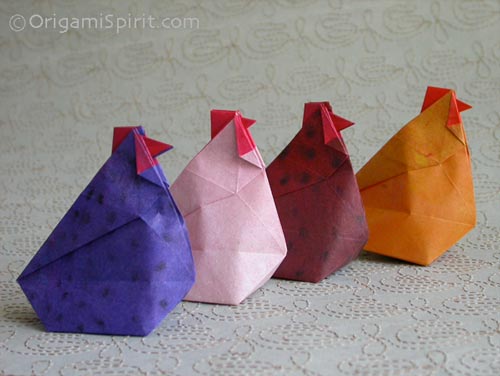
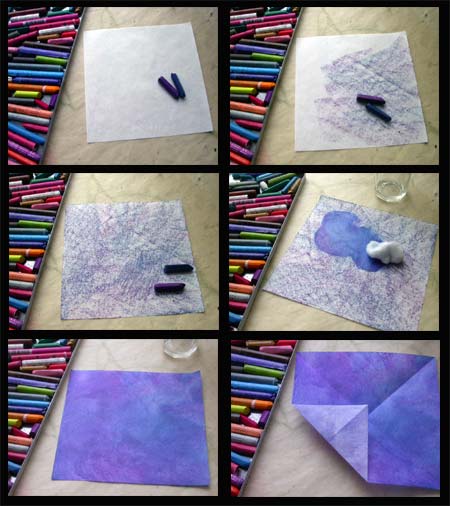
 On one side of the paper I add color by stroking the paper with oil pastels (Caran D’Ache Neocolor wax oil). I then rub the pastel color into the paper using a cotton ball and a drop of turpentine or mineral spirits. The turpentine dissolves and dilutes the oil color, and the cotton ball allows for delicate manipulation. As I rub the now colored paper, the color is spread over the entire surface . The resulting layer of color is bright but not too uniform with a marbleized texture from the hand manipulation. (see photo of the coloring process). The hens in the photo above are an example of how this coloring looks.
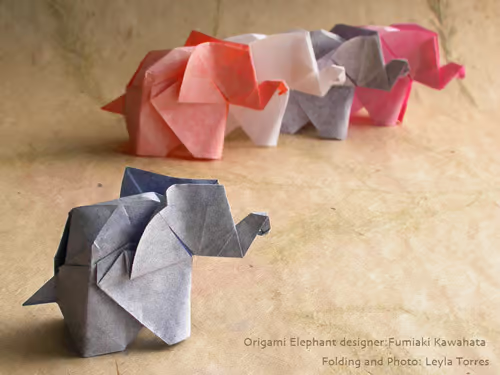
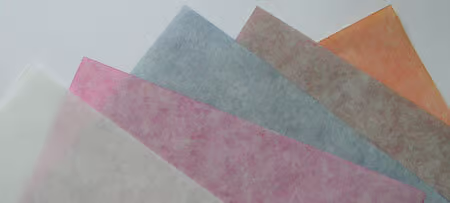 Since the paper is translucent, when turned over the color appears more subtle and more uniform than it does on the colored side. I have folded paper prepared in such a way so that the uncolored side is to the outside of the finished model as in the case of the elephants below (creation of Fumiaki Kawahata).
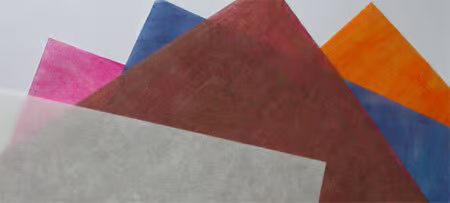
Onion Skin Paper vs. Tracing Paper
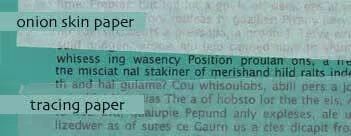
This picture shows the difference between one and the other. As can be seen, tracing paper is thinner and more translucent. Tissue paper (not pictured) is also translucent but definitely thinner than either onion skin or tracing paper.
Here is a related post on how to decorate Onion Skin paper to make butterflies.
Please do not use the linseed oil to color paper:
https://www.youtube.com/watch?v=9yq6VW-c2Ts
Linseed oil can catch fire by itself. It evaporates very quickly, so I suppose that the mechanism of catching on fire is quickly evaporating and moving molecules, which run into each other and get warmer and warmer. It is called spontaneous combustion.
Linseed oil has been used traditionally for hundreds of years as a paint medium. Read here: https://en.wikipedia.org/wiki/Linseed_oil
Paint binder
Linseed oil is a common carrier used in oil paint. It can also be used as a painting medium, making oil paints more fluid, transparent and glossy. It is available in varieties such as cold pressed, alkali refined, sun bleached, sun thickened, and polymerised (stand oil). The introduction of linseed oil was a significant advance in the technology of oil painting.
Only rags soaked with linseed oil stored in a pile are considered a fire hazard because they provide a large surface area for oxidation of the oil.
I was wondering if you had used the technique with pastels to color tracing paper? Since tracing paper is so much thinner I am wondering if it would still wrinkle?
Hi Chris,
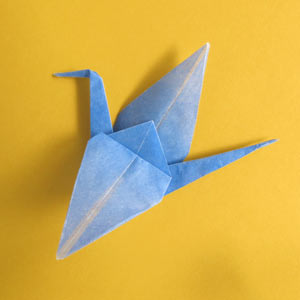
I have used it on tracing paper. The oil pastel takes well and leaves intact the translucent quality of the paper. It does not make the paper wrinkle. Here I post a sample:
Thank you! I am going to try it out this weekend. My approach with oil paint and brush was definitely *not* the way to go :)
Hey, Leyla ^^
is it ok if I use linseed oil? not turpentine as you demonstrated…
I haven’t use it, but don’t see why not. Try and see!
I will (^v^)
Thank you. I will check this out. =)
Hello,
This is not a origami related question, but I hope you can still help me somehow. I came across your site through Google, while searching for different types of paper. I am wondering if onion skin paper can be used in a laser jet printer? I have a project I am wanting to do, and I need to print out the (very long) poem. I then want to try to make the paper look slightly aged, if possible. When I read the link to your page about dying onion skin, that gave me a lot more ideas for color. But my main concern now is the printing. Do you know if I can print on OS paper?
When I found out that onion skin is the same as Bible paper, I though, “How perfect”. The project I am wanting to do is a poem titled The Old, Old Story, by A. C. Hankey. The hymn I Love To Tell the Story was based on this poem, I understand. Since it is the story of Christ, how fitting if it could be printed on Bible paper.
Anyway, any help or advice you can provide would be most welcome. I do not know anything about different types of papers, and the many things that can be done with and to them (dying, staining, etc.). I appreciate your time, and I enjoyed your wonderful creations in the photos above. I love elephants! =)
Thank you so much,
Caty
Hi Caty,
I haven’t used this paper in a laser jet printer. At the online store I linked to on my post, they offer a sample package of 7 Onion skin sheets of paper. Perhaps you could buy yourself one of those and test in your particular printer. I understand that being able to print on O Skin paper depends on the printer you have.
Click here to visit The Paper Mill Store (I am not affiliated with this business).
Is your onion skin paper close to the “old” onionskin from 70 years ago? I know what the “old” onion skin could do for me, but not knowing what people are selling as onionskin today keeps me wondering what to order.
Dear Marguerite, thank you for your question. I wish I could give you an accurate answer but my only experience is with the onion skin paper I feature here.
I don’t have a way to compare it with any other paper produce in earlier times.
hello, if I want buy onion-skin paper size of full sheet – 84.5×64.4cm. Where should I buy? tks
Hi Chris,
Other than the link I have in my post, I don’t know of onion skin paper in large sizes.
You might want to click on the link and ask them directly.
I would also be interested in getting the diagrams for this adorable elephant!
I looked on-line to try to find “elephant Kawahata” but the only elephant of his that is pictured on Gilad’s site is different. I looked at the on-line database and found several listings for elephants by Kawahata, and assume that there are at least two different models, but without pictures, it’s impossible to tell which is which.
I did find another reference to it: http://www.23hq.com/origami/photo/256008 but it also questions where to find the diagrams.
Do we know why Ravi Apte’s site is no longer hosted? I tried to follow a link but it seems to be co-opted by Google. If it was posted once, I hope that it was done so by permission, but unless we can get in touch with Apte or Kawahata, it should not be assumed that it is in the public domain.
I will post this question to the O-list and hopefully someone can shed some light one way or the other.
Thank you Leyla for sharing this. What you show us is always such an inspiration.
Elefants are some of my favorite animals and so I am wondering is there a CP, diagram or video for yours so I could try to fold one those beauties?
Steps folds for this elephant used to be in the internet, but they are no longer posted!
really great little pieces. thanks for sharing.
Any idea where to find onion skin paper? I live in Greece and its unheard here. Amazon does not ship paper in Greece any European link which ships international?
Hi Anastasia,
At the moment I don’t know where in Europe you might get this paper, but try asking for “Bible paper” or “India paper.”
Hi Anastacia
after some research I found that in German onion skin paper is called “Dünndruckpapier” and is available here:
http://www.papier-und-mehr.de/kreativepapiere/produktbeschreibungen/duenndruckpapier_creativFLORPOST.html
I hope that helps.
Thank you for the link Christine!!
I remember when I was in kindergarten, the teacher had us put crayon shavings between two sheets of waxed paper and then she ironed them. Then we put them under a sheet of construction paper with the silhouette of an egg, or chick so that we could make an Easter card for our parents. I think that we did something similar with a heart for Valentine’s day.
You could hang it up like stained glass in a window and it was pretty when the light shown through it. I had forgotten about it, but you might be able to use the laminated waxed paper to fold origami with too. Depending on the model you could even iron it again after it was folded. You could use a pressing cloth or another sheet of paper so that the wax doesn’t get on the iron.
I have folded with Vellum (tracing paper) before. Some Vellum is stiff and is not forgiving in reversing folds. Might work for something that you have a simple crease pattern for if you scored the paper before folding. I will have to try the onion skin!
I wonder if you could use alcohol or something else as a solvent for the oil pastels so that it wouldn’t smell as much, or does the smell of the turpentine dissipate?
Hi Susan,
Isn’t it nice when something triggers far away and fun memories? Thank you for sharing your kindegarten story about this techniques. I have folded wax paper and like it for models such as the flapping bird. Somehow the wings flap much easier if the bird is made with it.
You can buy odorless mineral spirits and turpentine. I use odorless mineral spirits successfully for my allergic nose.
Hi Leyla – I am looking at the the 5 petal star in the 10th photo frame shown at https://www.origamispirit.com/2012/04/16/how-to-color-onion-skin-paper-for-origami/ – is there a chance you have video or diagrammed instructions for this beautiful piece.Thanks for all your kindness in sharing your origami.
Helen
Hi Helen,
I featured that star with links to diagrams in this post:
https://www.origamispirit.com/2011/12/01/do-it-yourself-holiday-decorations-gifts-and-greetings/
It is made with an hexagonal piece of paper.
Thanks so much for reposting this! I have tried it per the original article & it works great. I have to try the duo- effect now (and get some more good-quality oil pastels…I tried with a cheap brand from Michaels’s & the color didn’t dissolve at all). You papers are beautiful!!
How fun! I’m going to have to try this! It seems like a great way to get the color combinations you want but can’t find to buy. Thanks!
Yes, it gives you a lot more color choices!