



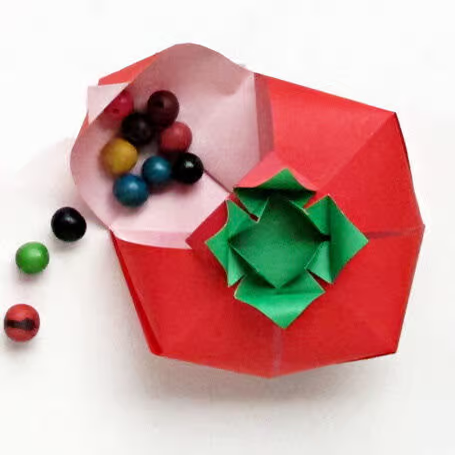
Based on the traditional Japanese menko, this brilliant origami box, created by Carlos Bocanegra, will become one of your favorite origami boxes for sure. So, find yourself a couple of pieces of origami paper, sit down and let your fingers do the tomato dance!
Not only will Carlos’ model offer endless pleasure in the folding, but his origami box will teach other basic origami lessons as well. And all the while serving as a prime example of how to be creative with origami!
How did Carlos develop the idea for his origami box?
To the original Japanese paper envelope, Carlos added a few folds which turned the flat menko into a 3D form. For the leaves, he then made a smaller menko and left it flat. The flaps of the larger menko/tomato are inserted into the smaller menko/leaves.
The flaps of the tomato remain fixed to the smaller menko through the friction of the paper. To keep the flaps of the tomato from pulling apart, the leaves may be secured with a small dab of glue.
To secure the flaps of this origami box without the need of glue, I came up with a variation for the top, using a windmill base.
Here is the video showing how to make the tomato base and two different tops of this origami box. Thank you Carlos for your permission to present this fabulous model.
Suggestions and tips
– Become familiar with folding the menko shown in this video.
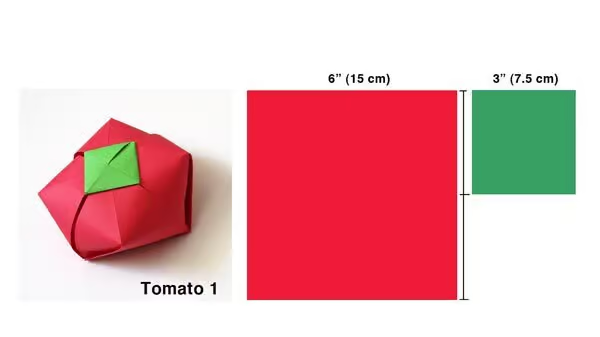
– For the original box, as Carlos designed it, you need two squares of paper: a big red square and a small green square.
– Paper with the same color on both sides is preferable, but duo color will do as well.
– Paper Size The base can be made with any size square, and the leaves with a square whose side is half of the bigger one. For example: 6 x 6 inches (15 x 15 cm) for the big square, and 3 x 3 inches (7.5 x 7.5 cm) for the small square.
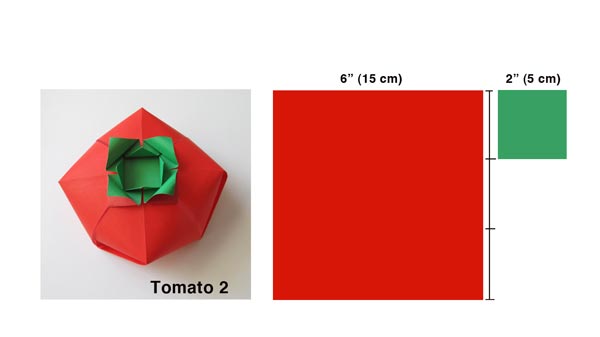
– For the second version, make the leaves with a square whose side is one third of the bigger one. For example: 6 x 6 inches (15 x 15 cm) for the big square, and 2 x 2 inches (5 x 5 cm) for the small square.
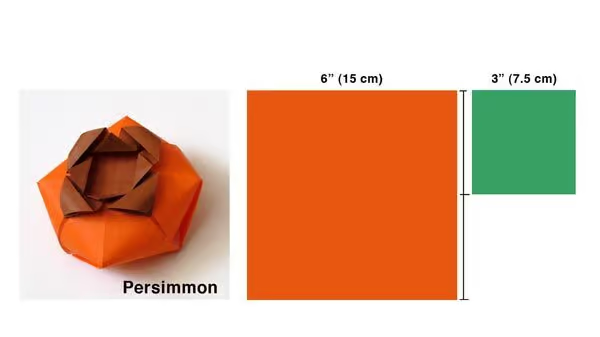
-To make this origami box look like a persimmon, use an orange square for the base and make the leaves with a brown square whose side is half of the bigger one. For example: 6 x 6 inches (15 x 15 cm) for the big square, and 3 x 3 inches (7.5 x 7.5 cm) for the small square.
– Types of paper The paper can be regular origami paper, but I’ve found that thicker paper such as colorful office paper works even better.
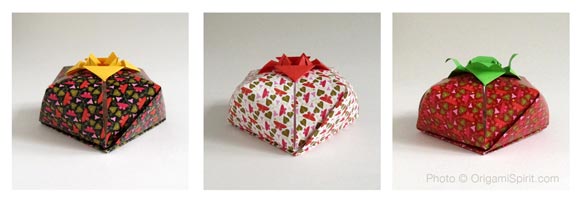
– I also made these origami boxes using printable patterns of my own design. I printed the patterns on white office paper. They work great!
These paper designs are available for sale on this website as an instant download (pdf file). Your purchasing these printable patterns will add some nice options to your collection of origami papers, and will support our bringing you video tutorials like the one posted on this article.
Click here to buy unique printable origami paper designs.
. . . . . . . . . . . .