
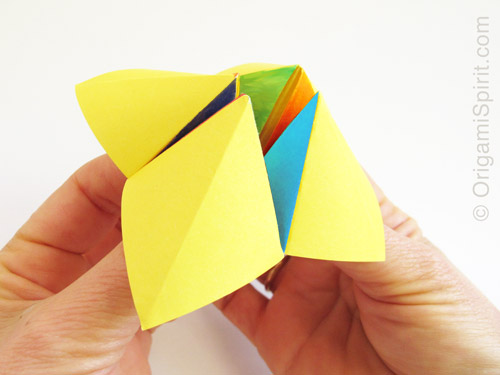
Do you remember playing with this traditional paper toy? It belongs to a select group of traditional origami models. It is known as a fortune teller, or cootie catcher. Below there are more names, in many languages, by which this toy is known along with how it is used.
As a fortune teller the holder of the model asks someone to name a number from one to ten and then opens and closes it as many times as the number mentioned. The holder then asks that a color be named, lifts the flap of the chosen color, and reads aloud the message within.
As a cootie catcher tiny dots are drawn on the model to represent bugs. Passing it gently through someone’s hair all the little bugs that were “caught” can be shown.
Here is a video describing how to make this model.
- Catalan: quatre sabaters
- Danish: flip-flapper, farveskifter, farvevælger, nip-napper, rap-rapper, spå, spå-maskine”, rip-rapper, lusefanger, saltkar
- Dutch: knip-knap, peper- en zoutvaatje
- English: fortune teller, cootie catcher, salt cellar, chatterbox, whirlybird, snapdragon
- French: coins-coins, salière
- German: himmel und hölle or himmel oder hölle, salz und Pfeffer
- Greek: Alatiera (Αλατιέρα)
- Hebrew: qua-qua, quaqua de la Roma
- Hungarian: sótartó
- Italian: acchiappanaso, inferno-paradiso
- Norwegian: Spå
- Polish: niebo-pieklo
- Portuguese: inferno e paradiso, quantos queres
- Spanish: adivinador, sacapiojos, salero, pollito, comecocos, sapito, cielo e infierno, día y noche, piquito, cuatrobocas, cumpleaños, el poto de doña María, juego de la fortuna, aguaderas, estafador de sueños
Aditional uses of the Fortune Teller
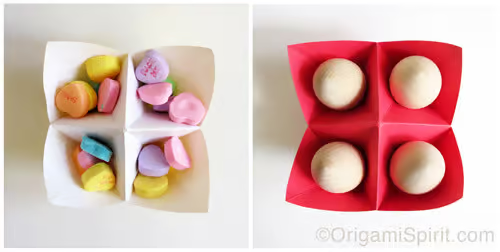
- When turned over it can be used as a container (salt cellar!) to place spices or candy.
- Made with a paper about ten inches square an egg holder can be made. It’s not very stable, so I would only recommend using it to hold hardboiled eggs. ;-)
Related posts
How to Fold an Origami Peacock
9 Ways to Awaken Your Creativity With Origami
————
What is the japanese name???
And I hear it is also called snapdragon.
Thankssss
Snapdragon sounds great. I will have to look for the Japanese name… I don’t know it. If I find it out, I will post it here.
Awesome! I made the fortune teller and modified it a little. I ended up making what I call an Advice Star! It’s a four- pointed pop-up star I learned to make in another origami website. Under it are the colors that I wrote. You have to choose one color and then choose a number on the color’s side. Lift the flap and there’s today’s advice!
Hola Leyla! hace un tiempo, subimos a la página de origamichile una versión imprimible del comecocos, para jugar a las adivinanzas. les dejo el link por si les interesa.
un abrazo
http://origamichileblog.blogspot.com/
Gracias Alicia por poner el enlace, muy bonito y muy divertido!!
El enlace directo a este comecocos es http://www.origamichileblog.blogspot.com/2012/02/comecocos-para-el-dia-de-los-enamorados.html
PS Alatiera means “salt and paper shaker” in Greek.
In Greek the name is Alatiera (Αλατιέρα) the kids make them and writte future predictions inside (like “you are going to be queen of the world”, or ” you are going to be the village fool”) One kid tells a number from one to ten then the other folds and unfolds alatiera as many times as the number, then the first kid chooses a quarter and reads his or hers foretold.
In a Chinese book (ISBN 957-692-002-7) N, S, E, W are written on the top four squares.
I’ve never heard of the Dutch name knip-knap before or any other name for that matter, it’s commonly known as ‘peper- en zoutvaatje’ (salt and pepper shaker). Kids mostly use it as a fortune teller although they often use mildly abusive words as well, as kids do at a certain age.
I’m also not sure about the French word coins-coins but that may be correct. There are a lot of ambiguous terms in the French language, coins-coins means corner-corner and coin-coin means quack-quack. I’ve always called it a ‘salière’ (salt shaker) and everybody seemed to understand what I meant.
Hi Miranda, I added these terms you shared to the post, thank you!
My source for knip-knap was a magazine from my niece, who happens to be Dutch.
The French word was contributed by a friend living in Quebec.
In Hebrew: Qua-Qua (representing the imaginary sound the model would make as a puppet…). This model is mostly used by Israeli kids as a fortune-teller.
Thank you Gilad. I also heard that in Israel it is called “quaqua de la Roma”
For the Himmel und Hölle (translates to heaven and hell) you have to paint the inside in one directions it opens blue (heaven) and on the other direction red (hell). Then you ask someone where there is heaven and he has to indicate one direction. You then open it to reveal whether he was right or not.
We have to play together! But I think I’m in Heaven already when I fold paper!
When I was a child, before I learned any origami (apart from things like this and paper planes,) I used to make a hand-puppet out of one of these. Glue two of the sides together, so that it only opens one way. Then draw eyes. Also maybe stick on some teeth cut out of paper and a long snake tongue.
That’s a clever way to use it David. Thank you for sharing! Now I remember that on his website, Hans Dybkjær features a little dragon based on the cootie-catcher folds. http://papirfoldning.dk/Diagrammer/Fugl11.html
I was thinking the other day of how we used these as kids to do fortune-telling. The binary flip-flop and the four axes, I thought, would be readily adaptable to do the personality index stuff that is so popular in the human resources world. You know, the Myer-Briggs test or the DISC test or any of those silly things. You could just use binary questions and assign numbers to the answers and after some toing and froing with the model, announce confidently, “You’re an introverted, detail-oriented, team-player with purple dots!”
I am not familiar with those human resources tests, but this idea sounds like a sophisticated use for this toy. We should design the test and ask people to play ‘personality indexing’ at the OUSA convention!
In a similar vein I once designed one as a “decision machine” for the local Roskilde Festival (last year: 130.000+ visitors) which was printed in the festival news paper which each day would bring an “origami reuse” diagram that could be folded from the newspaper.
http://papirfoldning.dk/da/ugensfold/2009-27.html http://papirfoldning.dk/images/diagram/RF2009/beslutter01.png
The orange tent in each corner is their logo, depicting the major music scene.
The model lends itself for such purposes.
And some of the Danish names: flip-flapper, farveskifter, farvevælger, nip-napper, rap-rapper, spå, spå-maskine”, rip-rapper, lusefanger (and in the other capacity: saltkar).
many of which translate directly into the names of the other languages.
Best regards,
Hans
Great Hans I added these names to the post as well. Thank you!